Home
What's New Blog
Basics Modeling Gallery
Modeling College
Voice Your Opinion
Modelmaking Tips
eBay Offerings
Crafters Jottings
Your First Model
Find and be Found
Search Handbook
Modeler's Mall
News and Views
Practice Modeling
Quick Site Guide
Cash For Modeling
Got A Basics Question
More Basics
Get Motivated
Plan Of Attack Scale Decision
Virtual Research
Modelers Workbench
How To Build
Modeling Tools
Black Art
Mini-ModelMaking
Modeling Practice
Jig Headquarters
Download Center
Getting To WOW!
Scale Conversion
Environmental Impact
Digital Photography
How-to Question
Adding Movement
Models That Move Radio Control Geeks
Nitro Racing
RC Flying At War
Cell Phone Modeling
Family RC
Pirate Ship Model
Slot Car Racing
RC/Slot Question
Small Flying Model
Model Railroads Buildtorials
Family Trains
Grist Mill Build
N Scale in a Shed
N-Scale eBook
Z-Scale-Pictorial
Click Kits Showcase
Apartment Layout
About Download Ctr
MRR Question?
*
Model Ships Noah's Ark
Titanic
FREE Bounty eBook
Ironclad Excellence
Rigging Helper
My HMS Victory
Quality Ship Models
Ship Model Question
More Ship Modeling
Diorama Sinking
Static Models Scratch Challenge
New This Week
Black Widow Build
Military Models
Card Modeling
Modelers Quiz
Weathering Models
Diorama How To
Static Questions
*
Peer To Peer Laughter Mixer
eBay Shopping
Contact Us
Article Submitter
Model Investments
Modeling Friends
Murphy's Mandates
DandyFunk
Movie Models
Free Subscription
Loose Change Cinema
Search This Site
House Husbands
Rate Your Model
Links Below Need More Work RC Flight Challenge
Modeler Health
My N-Scale Layout
User Guide 6/7
Model Masters
Modeling Reviews
Coming Events
Your Own Business
Modeling Media
Scale Choice
Model Collecting
Italian Tutor
Modelers Review
Modelers Groups
Quick Buying Guide
Online Shopping
Modular Downloads
Your Local Weather
Glossaries
Hobbies For Seniors
Z Scale-Motoring
Online Build
Christmas List
Help A Soldier
Innovation Forum
N-Scale Scratch
Trafalgar Diorama
Site-Map
Privacy Policy
Model Trains
Modeling Funk
Ocean Diorama
Master Modelers
Modelers Creed
Top Toy Stories
Light, Sound and...
Sign Gallery
Signs of The Times
Christmas Village
Shed Build
Modeling Music
Multimeasure App
Emporium Seafood
Detail Painting
Diorama Prices Up
Facebook, Twitter Poll
Legos Bricks
DIY Duck
Solid Modeling
Titanic-2012 Update
Ghost Ship Model
Virtual Modeling
Cutty Sark Renewal
Dream Job
USS Iowa

[?] Subscribe To This Site

XML RSS
Add to Google
Add to My Yahoo!
Add to My MSN
Subscribe with Bloglines

Gauge Trivia Links Tracks Across Centuries

You will often hear the term “O Gauge” or “N Gauge” when referring to model railroading scales, more properly identified as O Scale or N Scale.

Gauge and scale are two of the most confusing terms. In model railroading, SCALE is expressed as a fraction of a real life-sized railroad. As an example, HO scale is 1/87 the size of real life-sized railroads. N scale is 1/160.

The designation “gauge” actually comes down from full-size railroading where it refers to the distance between the rails, actually 4-feet, 8.5 inches which is kind of a weird figure now that you look at it.

Research the term railroad gauge on the Internet and you will eventually come up with this interesting piece of trivia:

The U.S. standard railroad gauge (distance between the rails) is four feet, eight and a half inches. That's an exceedingly odd number. Why was that gauge used? Because that's the way they built them in England, and English expatriates built the U.S. railroads.

Why did the English people build them like that? Because the first rail lines were built by the same people who built the pre-railroad tramways, and that's the gauge they used.

Why did 'they' use that gauge then? Because the people who built the tramways used the same jigs and tools that they used for building wagons, which used that wheel spacing.

Why did the wagons use that odd wheel spacing? Well, if they tried to use any other spacing the wagons would break on some of the old, long-distance roads, because that's the spacing of the old wheel ruts.

So who built these old rutted roads? The first long-distance roads in Europe were built by Imperial Rome for the benefit of its legions. The roads have been used ever since.

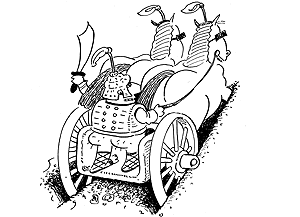
And the ruts? Roman war chariots made the initial ruts, which everyone else had to match for fear of destroying their wagons. Since the chariots were made for or by Imperial Rome, they were all alike in the matter of wheel spacing. Thus, the standard U.S. railroad gauge of four feet, eight and a half inches derives from the specification for an Imperial Roman army war chariot.

Specs and bureaucracies live forever. So the next time you are handed a specification and wonder what horse's ass came up with it, you may be exactly right. Because the Imperial Roman chariots were made to be just wide enough to accommodate the back ends of two warhorses.

Questions? Comments? Please Use Our Contact Form


Enter your E-mail Address

Enter your First Name (optional)

Then

Don't worry -- your e-mail address is totally secure.
I promise to use it only to send you Scale Modeling Tips & Tools Monthly.