
|
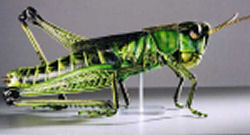
Scale Models: Exactly What Are TheyScale models are most often built or collected for pleasure as a hobby but have more serious uses in engineering or architecture. Our primary interest at Scale Modelers Handbook covers all sorts of subjects including aircraft, automobiles, fantasy, figures, matchstick models, military vehicles, monsters, paper models, railways, rockets, science-fiction and ships. Rationale? of Scales Often Baffling They come in a variety of sizes, sometimes being the exact same size or larger than the object they're based on , (for instance the 1:30 scale grasshopper pictured here) but more often than not they are smaller than the original. Some models - especially aircraft, cars, rockets and ships - may be radio controlled or enhanced with moving parts or lighting. Originally, a 'scale' was a physical measuring instrument, a notion that persists today as concerning weight. First among scales are engineer or architect scales that are triangular rulers (in cross-section). Terminology used was 'scale size to full size', or the reverse. An architect's scale was used to make the first affordable models that were dolls houses and related furniture and miniatures. Popular scales for these miniatures were 'one inch to the foot' and 'one half inch to the foot. The proportions of the models to the prototypes were originally called 'size', as in 'full-sized' or 'half-sized', as used on a blueprint for making something that would fit on a workbench.
NOTE: There is a vast difference in depicting a scale reference as either one inch equals one foot or one foot equals one inch. The same can be said for depicting scales as either 1:30 or 30:1. During the Second World War, battleship models (because of the originals length) were made 'eight foot to the inch' which later became 'one eighth inch to the foot'. The model ship would be referred to as 'one ninety-sixth size', or '1/96th'. There were also rotary instruments in which marks on two dials could be lined up in order to translate measurements from units on the prototype to units on the model. When the production of plastic hobby model kits became an industry, rulers were developed marked in model units called scales and today 'larger' and 'smaller' phrases are used when comparing them. For example, the scale of '1/8" to the foot' is a 'larger' scale than '1/16" to the foot', even though the denominator is smaller. So a larger model is made to a larger scale. You can remember this in that a full-size, or full-scale, model is larger than a half-size model. Although some consumer models were sold pre-war in Britain to this scale, the airmens' models were pressed out of ground-up old rubber tires, making them the first plastic kits. After the war, manufacturers started molding models from polystyrene for sale in the consumer marketplace. In the early years, firms offered models of aircraft and ships in 'fit-the-box' size. A box that would make an impressive gift was specified, and a mould was crafted to make a model that wouldn't ludicrously slide around inside. Modellers could not compare models, nor switch parts from one kit to another.
The idea of building commercial ship models to a standard scale traces its roots back to an Englishman whose life began as the Civil War was ending in the United States. John Frederick Thomas Jane was born in Surrey in 1865. His father was a vicar, but Jane's ancestors included sailors and explorers whose influence clearly shaped the young man's future interests. As a boy, Fred T. Jane enjoyed having naval battles on the village pond and developed a system of signals later used by the Royal Navy. By the time he had reached his teens, he had begun a book of ship drawings entitled "Ironclads of the World" In 1889 he published the first edition of "Jane's All The World's Fighting Ships", which quickly became the authority on ship recognition, establishing a position the Jane's guides have maintained for more than 100 years.
|
|||||||||||
 Long before there were toy cars or airplanes, there were toy boats. The earliest scale models of watercraft are lost in history, but there is a time-honored tradition of lovingly crafted replicas that we can still see today. Whether it's the old "ship in a bottle" or a museum-quality man-o-war, there is a captivating magic to ship models.
