|
Grind Your Own Ground Cover
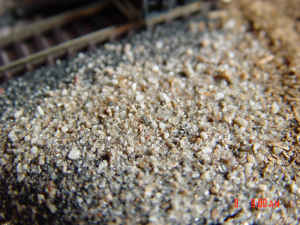
Whether your modeling niche is dioramas, model railroads or RC racing, sooner or later you'll want to produce some dirt for a realistic ground cover. Up until now, I had resorted to nature's best out in the backyard, sand left over from the winter treatment. I waited until my wife was out of the house before giving it the drying treatment. It involved her cookie pan, and sitting in a 150-degree oven for two-three hours. Then I ran it through a couple of sifters to segregate different sizes and pick out non-sand items. In the end I wasn't happy with it, the grains were just too large to look realistic.
It had two problems for an N Scale layout: individual grains were still bigger than N Scale ballast or some boulders and sand includes mica which offers a bright sparkling shine where there should be no shine. It was also pretty even in color so I mixed in some coffee grounds so I ended up with dark blotches, still not looking right. I needed something the color of dried oak leaves so I bagged a bunch of dried leaves and proceeded to hand-grind them getting nowhere fast. Leave it to my wife to come up with a fantastic solution--a coffee grinder--we've had one for years and that's about how long ago we used it. I crammed a load of crunched up leaves into the grinder and gave them a whirl, shaking the grinder every now and then to shift the fragments into the blades.
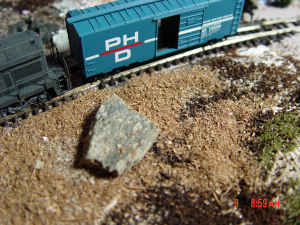
When finished I ran the contents through a kitchen strainer and what emerged was a fine, multi-colored powder. The individual particles had the right size and color and provided a good contrast to the sand already glued in place.. For me, ground up dead leaves works fine and has an appropriate appearance for N Scale dirt. The grinder also produces some fine strands (probably leave stalks) that give the appearance of twigs and sticks which is a neat bonus. I'm lazy and cheap sometimes, I just paint the surface to receive ground cover with good old wall latex/vinyl paint and then sprinkle it on while thepaint is wet. If I think it needs it, I'll spritz the foam with wet water to better mingle the paint and leaf particles. I am a little leery about using too much water as it tends to ball up the “dirt”. If I think it really needs it, I'll waituntil this is dry so it doesn't move around, spritz it until it's damp again, and dribble on diluted matte medium and let it dry. There! Done!
|