N Scale ModelLayout In A Woodshed
The Railroad modeling hobby is an insistent bug and once you are bitten it just sits there and festers until you do something about it. I got an N-Scale bite about 35 years ago In Vermont and it has never really healed. I still get flare ups every time I hear the Boston & Maine whistling for a grade crossing.
Having a Senior Moment?
Strangely enough, back in Vermont, I lived in what might be described as a railroad intensive town ideal for scale modeling. The town grew up right on the Connecticut River flanked by tracks, bridges, tunnels, a roundhouse (out of use) and a neat little railroad station. It was easy to kitbash structures and getting accurate measurements for scratch building was no problem.
| My first N Scale Layout was banned from the house all together. Scale Model railroading was a hobby I got years of enjoyment from in the woodshed behind my Vermont home; it was an ideal building, close to the house, no windows and roughly seven by 12 feet in size. Just right for an N-Scale empire.
Limit Your Hobby's Footprint...for a while
In there I created another world at 1:160, no wars, no angry bosses, no strife. It was pretty much designed the way I wanted it. | | I got to do it all from creating U-shaped bench work to powering and wiring the track and lighting and providing a hefty overdose of scenery complete with a village, factories, lumber operations, a cannery, almost anything that could justify shipping by freight car. Scratch building anything from a row of three deckers to a rundown and abandoned line shack (no it wasn’t modeled after my shed) but it turned out to be my wife’s favorite and the only survivor of the late 1970s HardyMont RR. polyester casting resin to simulate water.
N-Scale-Model-Layout planning
To some model railroaders. the concept of scratch building has no significance; they build models as they like and are not bothered dimensional accuracy which may have little or no meaning [to them now or] in future years. I try to replicate things from my imagination coupled with images I have retained over far too long a period of time. The line shack at the left is an example. It was one I worked on for two or three days. | 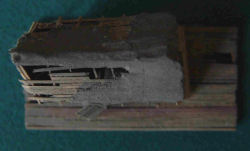 | | 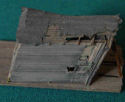 |  | | 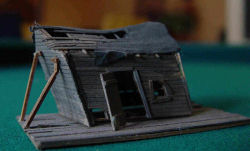 | | Each wall board and roof strut was individually cut and stained. The roofing material is toilet paper, torn, not cut and than painted a dull black. Time wasn't good to the original and it is taking its toll on the model. Live Research From Your ComputerGoogle Earth and MSN's Virtual Earth can make a big difference in researching the terrain you are modeling by zooming in on the scene whether it is a mountain canyon or a rocky ocean coastline. These tools take photos to a new level. Not only do you get a clear picture, but you can view it from any angle and in most cases, view it in 3-D.
Virtual Research Pictures Here
Constructing scenery generally involves preparing a sub-terrain using screen wire, a lattice of cardboard strips, or carved stacks of expanded polystyrene (Styrofoam) sheets. A scenery base was applied over the sub-terrain; typically I used casting plaster, plaster of Paris or papier-mâché. I fabricated trees using natural materials such as a variety of weeds aqnd in some cases applied adhesive to attach model foliage. | | | |
The Bug Bites Again
|


