
|
Hobby Painting Practice Pays Off
|
|||||||||||||
|
|
Painting Tips
You'll find It's definitely easier to paint plastic parts separately before you start gluing them together.
Sometimes the paint that you buy is not at quite the correct thickness. A rough test is to dip the brush in the paint and hold the brush up so that the paint drips back onto a newspaper. If the paint falls off in great globs, it's too thick. If it drips fast, it's too thin. You can use normal thinners or turpentine to thin your paint, just make sure you mix it in well - and
go slowly! You can't un-add thinner to make it more thick!
Try Painting Practice With a Bottle Drill
You generally need at least two or three different sized brushes - a small, fine one, for doing detail, and a medium-ish one for doing large parts and a bigger brush for the main bulk of the painting. You will find there is a wide range of brushes (and prices) - camel hair, etc. etc. I've found that you don't really need the expensive ones - the cheap ones do just as well . You must make sure that the brush is suitable for enamel paint - you shouldn't use the kind for artists or for kiddies waterpaints.
Whether you paint parts while they're still on the sprue (the frame thing they're all attached to) or not, you're still going to have to touch up parts you couldn't reach the first time. If you paint on the sprue, be careful not to get paint on other parts; either way, wait until the paint is totally dry before you touch up - otherwise you'll have fingerprint marks on your paint.
Unless you're using really thin paint, don't worry too much about doing second coats, or base coats. Most parts will get at least a partial second coat when you touch up, but if they don't, it will still look fine. Of course, if you see obvious holes, you know what to do.
The most important painting process you need to master is masking, you need the ability to two colors adjacent to each other with a neat, straight edge between them. This is a good routine to practice until you have it perfected. You can work with any old peice of plastic of Lexan, (how about an old coffee cup), and you can try it on the underside of large areas that won't show when the model is finished. Here's a shape you can work with on your masking technique.
One side of the line will be green, the other will be black. For your practice, use any two colors you have handy.
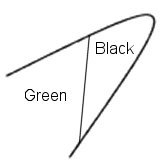
Use this shape or any other you can segment with a line to separate the two colors.
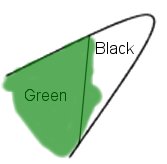
Start with the lightest color, and paint the section that you want that color (it doesn't have to be exact, but rather exceed the area than not fill it in completely).
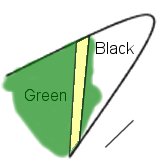
Now, wait for the paint to dry *completely* - I recommend at least 24 hours. When it's dry, take masking tape and stick it down over what you painted, along the line of where you want the next color to go.
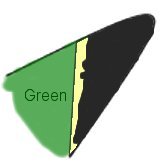
Now you paint with your 2nd color, and you don't have to worry about getting it on your first color because the first color is covered by the masking tape!
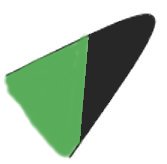
Wait for the paint to dry (again, I suggest at least 24 hours) and then *gently* pull the masking tape off. Now you have a nice neat line along the two colors!
You do need to be careful: sticky tape can spoil the surface, especially for glossy paints, so stick the tape to your desk or something a couple of times first. Don't take the tape off until the paint is completely dry.
When you use masking tape, make sure you rub the edges down well, otherwise paint may seep in underneath. Also, paint away from the edge of the tape - this avoids leaving a ridge of paint when you pull the tape away, and probably also helps to avoid seepage.
Painting curved edges, even on flat surfaces, can be fairly tricky. Getting the tape to have just the right curve is difficult - if you cut it to shape, then stick it, it'll never fit right; if you stick it, and then cut it, you run the risk of scratching or even cutting in to the plastic. I've never found a good solution - if you know of one, please tell me!
| More Painting and Weathering Lore | ||
| Paintinga Black Art | PaintbrushCare | PaintingTutorial |
| AirbrushPreparation | PaintingPractice | UltimatePaint Job |
| WeatheringTechniques | AirbrushBasics | WeatheringTips |

SBI!
